
FDA 510k Submission: Process, Timeline and Clearance
An FDA 510k submission is the premarket notification most Class II and some Class I medical devices need before they can be sold in the United States. It shows the FDA that your device is substantially equivalent to a device already legally on the US market. When the FDA agrees, it issues a 510k clearance letter and a 510(k) number, and the device can enter commercial distribution.
This FDA 510k submission guide covers the full 510k pathway: when a 510(k) is required, choosing a predicate, what goes into an eSTAR submission, how the FDA review clock works, realistic 510k submission timelines, FY 2027 FDA fees and what you must do after clearance. MedDeviceCorp prepares and files 510(k)s for manufacturers from its offices in India, the USA and the UK.
Reviewed by Beena P, Manager – USFDA Regulatory & Operations, 15+ years in regulatory consulting · Last updated: October 2026
Get a 510k QuoteOur 510k Consulting ServiceWhat Is an FDA 510k Submission?
A 510(k) takes its name from Section 510(k) of the Federal Food, Drug, and Cosmetic Act. The detailed rules are in 21 CFR Part 807, Subpart E, and the FDA explains the program on its Premarket Notification 510(k) page. A 510k submission is a premarket notification: you notify the FDA that you intend to market a device, and you provide evidence that it is at least as safe and effective as a legally marketed device, called the predicate.
The central test is substantial equivalence. Your device must have the same intended use as the predicate and either the same technological characteristics, or different characteristics that do not raise new questions of safety and effectiveness and are supported by data.
What is a 510(k) number?
When the FDA finds a device substantially equivalent, it issues a clearance letter with a unique 510(k) number. The number starts with "K" followed by six digits, for example K251234, where the first two digits show the year the submission was received. The number is published in the FDA 510(k) database and is used later when you list the device with the FDA.
A 510(k) number is not an establishment registration, a device listing or an FDA approval. It is evidence that this specific device, with its stated indications for use, has been cleared.
510k Clearance vs FDA Approval: What Is the Difference?
Many people search for "510k approval", but the correct term is 510k clearance. The FDA clears devices through the 510(k) pathway because the decision rests on comparison with a predicate. It approves devices only through Premarket Approval (PMA), where the manufacturer must prove safety and effectiveness on its own data, usually including clinical trials. Calling a cleared device "FDA approved" in marketing is misleading, and the FDA treats it as misbranding.
You will also see the terms "510k certification" and "US FDA 510k certification". The FDA does not certify devices, so there is no 510k certificate. What you receive after a successful 510k filing is a clearance letter (the Substantially Equivalent letter) with your 510(k) number, which is the evidence buyers and distributors ask for.
| Pathway | Typical devices | Basis of decision | Outcome |
|---|---|---|---|
| 510(k) premarket notification | Most Class II and some Class I | Substantial equivalence to a predicate | Clearance (K number) |
| De Novo | Novel low-to-moderate risk devices with no predicate | Reasonable assurance of safety and effectiveness with general and special controls | Grant (creates a new classification; can then serve as a predicate) |
| PMA | Class III | Independent proof of safety and effectiveness, usually with clinical data | Approval (P number) |
| Exempt | Most Class I and some Class II | No premarket review, within the exemption limits | Registration and listing only |
When Is a 510k Submission Required?
Under 21 CFR 807.81, you need a 510(k) at least 90 days before you introduce a device into US commercial distribution, and you cannot market it until it is cleared. A 510k submission is needed when:
- You place a device on the US market for the first time and it is not exempt.
- You change the intended use or indications for use of a device you already market.
- You make a change to a cleared device that could significantly affect its safety or effectiveness, such as a design, material, chemical composition, energy source, software or manufacturing process change.
FDA guidance "Deciding When to Submit a 510(k) for a Change to an Existing Device", plus a separate guidance for software changes, explains how to assess and document modifications. Changes that do not need a new 510(k) still need a documented rationale in your quality system files.
Who submits a 510(k)?
- Domestic manufacturers introducing a device to the US market
- Specification developers who design a device made by a contract manufacturer
- Foreign manufacturers and exporters, or their US representatives
- Repackagers and relabelers whose labeling changes or operations significantly affect the device
Is my device 510(k) exempt?
Most Class I devices and some Class II devices are exempt. Exemptions are stated in the device's classification regulation and are subject to limitations in the ".9" section of each device panel, for example 21 CFR 880.9. A device that goes beyond those limits, such as a new material or a different intended use, loses the exemption. Exempt devices still require establishment registration, device listing and compliance with the Quality Management System Regulation unless also exempt from it.
510k Medical Device Classification
Every 510k device starts with correct classification, because the class decides whether you need a 510k submission at all. The FDA groups devices into about 1,700 generic types across 16 medical specialty panels in 21 CFR Parts 862 to 892. Each type has a classification regulation number, a three-letter product code and a device class.
Class I
Low risk. General controls. Most are 510(k) exempt.
Class II
Moderate risk. General and special controls. Most need a 510k submission.
Class III
High risk. General controls and PMA. A few older Class III types still use 510(k).
Search the FDA Product Classification database by device name, then confirm against cleared devices with the same product code. If classification is unclear, a 513(g) request for information gives a formal FDA view.
Types of 510k Submission
Traditional 510(k)
The standard route for new devices and for changes that do not qualify for a Special 510(k). FDA goal: a decision within 90 FDA days.
Special 510(k)
For changes to your own cleared device where well-established methods can evaluate the change and the results can be reviewed in summary form. FDA aims to decide within 30 days.
Abbreviated 510(k)
Relies on FDA guidance documents, special controls or recognized consensus standards, using summary reports instead of full test data where allowed.
Third Party Review: For eligible device types, an FDA-accredited third party review organization can review the 510(k) and send its recommendation to the FDA. No FDA user fee applies, but the review organization charges its own fee. The FDA also runs pilot programs that change how some 510(k)s are reviewed; see 510(k) program pilots and the Quality in 510(k) Review Program pilot.
Predicate Device and Substantial Equivalence
Choosing the predicate is the single most important decision in a 510k submission. A weak predicate leads to extra testing, additional information requests or a Not Substantially Equivalent (NSE) decision.
How to choose a predicate
- Same product code and classification regulation as your device
- Same intended use, with indications for use as close as possible
- Similar technology, materials, energy source and design
- A recent clearance, ideally made with current guidance and standards
- No safety recall or removal from the market for safety reasons
You may use one primary predicate and, where justified, reference devices to support specific technological aspects. FDA guidance on "The 510(k) Program: Evaluating Substantial Equivalence" sets out the decision flowchart the reviewer follows.
The substantial equivalence comparison
Your submission includes a side-by-side table comparing your device to the predicate: intended use, indications, design, materials, energy source, performance, sterility, shelf life, software and labeling. Every difference must be explained and backed by test data showing it does not raise new questions of safety or effectiveness.
510k Submission Requirements and Documentation
Since 1 October 2023, all 510(k)s must be submitted electronically as an eSTAR (electronic Submission Template And Resource) unless exempted. eSTAR is an interactive PDF that guides you through each required section and checks completeness. Paper and old eCopy submissions are no longer accepted for 510(k)s. Good 510k documentation is consistent across every section of the eSTAR. Typical content includes:
| Section | What it contains |
|---|---|
| Submitter and applicant information | Manufacturer, correspondent, US Agent details, user fee payment ID |
| Classification and pathway | Regulation number, product code, 510(k) type |
| Indications for use | Statement of indications (Form FDA 3881 content) |
| Device description | Design, principles of operation, materials, models, accessories, drawings |
| Predicate comparison | Substantial equivalence table and discussion of differences |
| Labeling | Labels, IFU, patient labeling, compliance with 21 CFR 801 (809 for IVDs). See labelling in a 510k |
| Sterility and shelf life | Sterilization method and validation, packaging, shelf life, reprocessing if reusable |
| Biocompatibility | Evaluation to ISO 10993-1 and FDA guidance for patient-contacting materials |
| Software and cybersecurity | Documentation level, architecture, risk, V&V; cybersecurity under Section 524B for cyber devices |
| Electrical safety and EMC | IEC 60601-1, IEC 60601-1-2 and particular standards where applicable |
| Performance testing | Bench, animal and clinical data as needed |
| 510(k) summary or statement | Public summary under 21 CFR 807.92 or statement under 807.93 |
| Truthful and accurate statement | Signed certification by a responsible person |
Performance Testing for a 510(k)
Test data is where most 510k projects spend their time and budget. Plan testing early, based on the predicate, device-specific FDA guidance and FDA-recognized consensus standards.
Bench testing
Mechanical, dimensional, functional and durability testing against the predicate or recognized standards.
Biocompatibility
Cytotoxicity, sensitization and irritation at minimum, with further endpoints by contact type and duration. Biocompatibility testing.
Electrical safety and EMC
IEC 60601 series testing for powered devices, plus wireless coexistence where relevant.
Software
Documentation following FDA's guidance on device software functions, Basic or Enhanced level, aligned with IEC 62304. Software V&V.
Sterilization and packaging
Validation to ISO 11135, ISO 11137 or ISO 17665, plus packaging integrity and shelf life. Sterilization · Shelf life.
Usability
Human factors data under FDA guidance and IEC 62366-1 where use errors could cause harm.
Do you need clinical data for a 510(k)?
Most 510(k)s are cleared on non-clinical data alone. Clinical data becomes necessary when bench and animal testing cannot address a difference from the predicate, such as a new indication, a new patient population or a novel technology. Device-specific guidance often states when clinical data is expected. A Pre-Submission is the best way to confirm this with the FDA before you invest in a study.
IVD 510k Submission
In vitro diagnostic devices follow the same 510(k) framework but with diagnostic-specific evidence. A typical IVD 510k submission includes:
- Analytical performance: precision, accuracy or trueness, linearity and reportable range, limit of blank, detection and quantitation, analytical specificity and interference, carry-over and stability
- Method comparison against the predicate or a reference method, often following CLSI guidelines
- Reference intervals or expected values where relevant
- Clinical performance (sensitivity and specificity) where the device type requires it
- Labeling under 21 CFR 809.10
The FDA also assigns a CLIA complexity category after clearance. Point-of-care tests may combine clearance and CLIA waiver in a Dual 510(k) and CLIA Waiver by Application, which needs additional studies with untrained users.
FDA Pre-Submission (Q-Sub) Before Your 510(k)
A Pre-Submission is a free, voluntary request for FDA feedback before your FDA 510k submission, run under the FDA Q-Submission Program guidance. You send specific questions about your predicate, testing plan or clinical data, and the FDA replies in writing, usually within about 70 days, with an optional meeting by teleconference or in person.
A Pre-Sub is worth the time when your device has a new technology, a new indication, software or cybersecurity questions, or when you are unsure whether clinical data is needed. Agreements reached in a Pre-Sub reduce the risk of surprises during review. It adds roughly three months to the project, so plan it into your 510k submission timeline.
What to include in a Pre-Submission package
- Cover letter and CDRH Premarket Review Submission Cover Sheet (Form FDA 3514)
- Table of contents
- Device description and proposed intended use / indications for use
- Summary of any earlier FDA discussions or submissions for the same device
- Overview of product development and the planned testing
- Specific questions for FDA feedback (the most important part: keep them focused and answerable)
- Preferred feedback method: written feedback only, or written feedback followed by a meeting
- If a meeting is requested: format, three or more preferred dates, attendees and any audiovisual needs
FDA Pre-Submission timeline
| Step | Typical timing |
|---|---|
| Pre-Sub package sent to FDA (eCopy via the CDRH Portal) | Day 0 |
| FDA acceptance review | Within 15 days |
| FDA contacts you to agree meeting dates (if requested) | Around day 30 |
| FDA written feedback | Within 70 days, or at least 5 days before the meeting |
| Meeting held | Around day 70 to 75 |
| You submit draft meeting minutes | Within 15 days after the meeting |
| FDA comments on the minutes | Within 30 days of receiving them |
Why submit a Pre-Sub before your 510(k)
- A stronger, better-targeted 510(k) with fewer Additional Information requests
- Early agreement on predicate choice, test methods and clinical data needs
- A smoother and often shorter overall review
- No FDA user fee
FDA 510k Submission Process: Step by Step
The 510k medical device approval process, more accurately the clearance process, runs from classification to the FDA decision. The FDA 510k flowchart below shows the 510k filing steps on your side and the FDA review steps after submission.
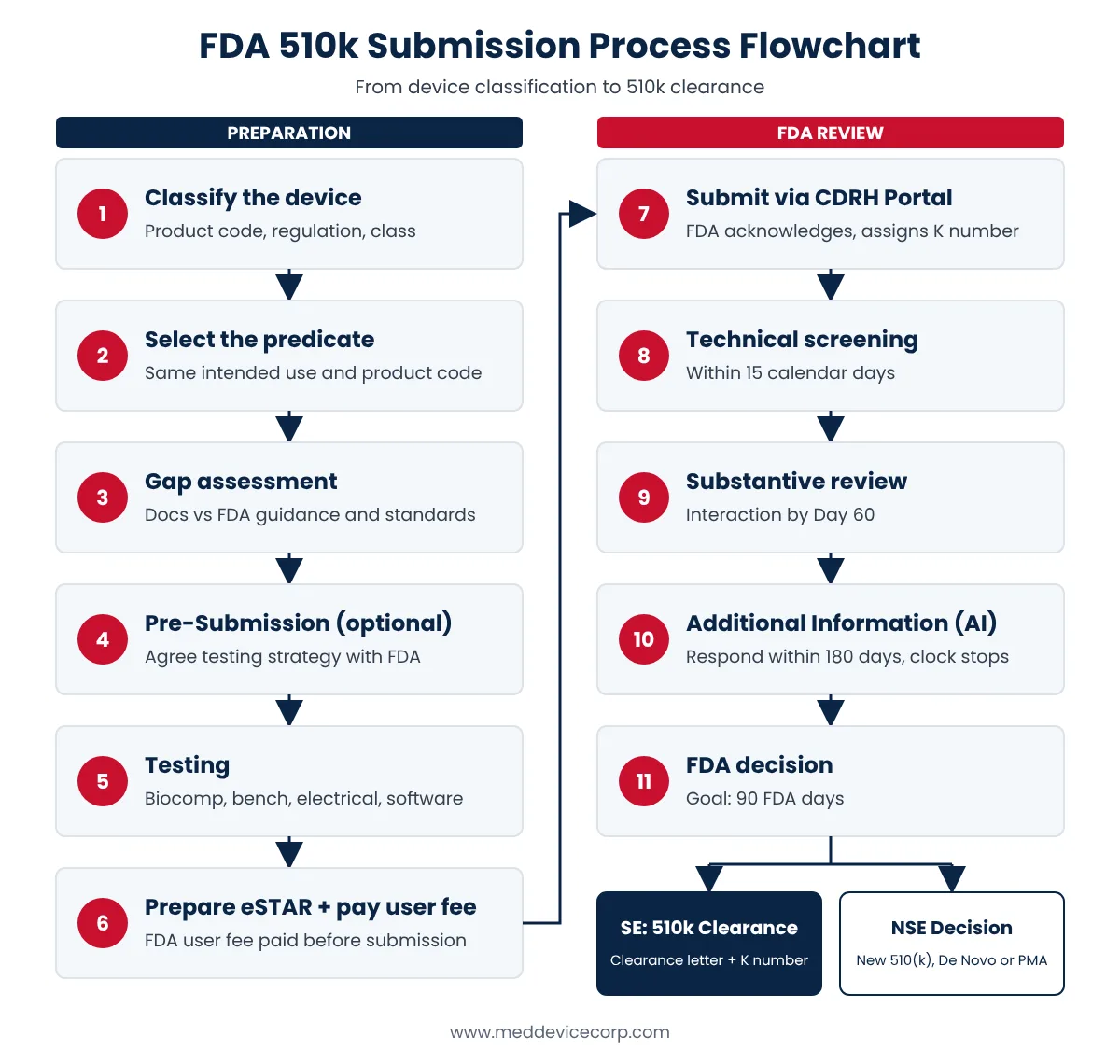
- Classify the device and confirm the 510k pathway, product code and regulation number.
- Select the predicate and build the substantial equivalence comparison.
- Gap assessment of your existing technical documentation against FDA guidance and recognized standards.
- Pre-Submission, where needed, to agree the testing strategy with the FDA.
- Testing: biocompatibility, bench, electrical safety, software, sterilization, shelf life and clinical where needed.
- Prepare the eSTAR, including labeling, device description, test summaries and the 510(k) summary.
- Pay the FDA user fee and obtain the payment identification number. Apply for small business status first if you qualify.
- Submit through the CDRH Portal. FDA acknowledges receipt and assigns the K number.
- Technical screening: within 15 calendar days the FDA checks the eSTAR is complete. An incomplete file is put on hold.
- Substantive review: by day 60 the FDA sends either an Additional Information (AI) request or tells you review continues.
- Respond to AI: you have 180 calendar days. The review clock stops while you respond.
- Decision: a Substantially Equivalent letter (510k clearance) or a Not Substantially Equivalent letter.
The FDA describes these stages on its 510(k) Submission Process page. If the decision is NSE, options include a new 510(k) with a different predicate or more data, a De Novo request or a PMA.
510k Review Timeline: How Long Does the FDA Take?
Under the MDUFA V performance goals, the FDA aims to decide on a Traditional 510(k) within 90 FDA days. FDA days count only the time the file is with the FDA. When the FDA issues an AI request, the clock stops until you respond, so calendar time is longer than 90 days.
| Milestone | FDA timing |
|---|---|
| Technical screening (completeness check) | Within 15 calendar days of receipt |
| Substantive Interaction (AI request or notice that review continues) | By day 60 |
| Applicant response to AI request | Up to 180 calendar days (clock stopped) |
| Final decision goal | 90 FDA days |
| Special 510(k) | 30-day review goal |
In practice, the 510k approval timeline (more correctly, the clearance timeline) from submission to decision depends mainly on how complete the file is and how quickly you answer the AI request. A file with strong predicate logic and complete test reports often avoids a second round of questions.
510k Submission Timeline: Full Project Plan
The FDA review is only part of the project. This is the typical end-to-end 510k submission timeline MedDeviceCorp plans with clients, from device selection to clearance.
| Phase | Key activities | Responsibility | Typical duration |
|---|---|---|---|
| I. Planning | Select the device and models, identify the predicate, confirm 510(k) vs De Novo or PMA, appoint MedDeviceCorp as consultant and US Agent | Client + MDC | About 20 days |
| II. Strategy and testing | Confirm product code and class, identify guidance, define biocompatibility and test needs, send samples to laboratory, review risk analysis, labels, IFU and shelf life, Pre-Submission | Client + MDC | About 90 days |
| III. Compilation | Incorporate Pre-Sub feedback, compile test reports, build the eSTAR and release the final draft for review | MDC | About 90 days |
| IV. Submission | US Agent appointment, FDA user fee payment, eSTAR upload via the CDRH Portal, acknowledgement | Client + MDC | About 20 days |
| V. FDA review | Technical screening and substantive review | FDA | Up to 90 FDA days |
| VI. AI response | Address FDA questions, provide added evidence and resubmit | Client + MDC | About 60 to 70 days |
| VII. Decision | Remaining review and 510k clearance letter | FDA | Remaining FDA days |
As a guide, 510(k) preparation takes 60 to 90 days, a Pre-Submission about 90 days, and FDA review cycles through to clearance usually 140 to 180 working days. Testing lead times at external laboratories can extend this.
FDA 510k Submission Fees for FY 2027
The FDA user fee is paid to the FDA before you submit. FY 2027 rates apply to submissions received from 1 October 2026 to 30 September 2027 (source: FDA MDUFA fees).
| FDA fee | Standard | Small business |
|---|---|---|
| 510(k) premarket notification | $28,653 | $7,163 |
| De Novo classification request | $191,020 | $47,755 |
| Annual establishment registration | $13,785 | $13,785 (no reduction) |
Small business status (gross receipts of $100 million or less, including affiliates) must be approved by the FDA for each fiscal year before you pay. If you submit before qualification, you pay the standard fee with no refund of the difference.
Consulting fees are separate. See our 510k consulting packages and fees.
After 510k Clearance: What Comes Next
Registration and listing
Register the establishment and list the device, referencing the 510(k) number, and pay the annual registration fee. US FDA Registration.
US Agent
Foreign establishments must name a US Agent who lives or has a place of business in the US. US FDA Agent.
Quality system (QMSR)
Since 2 February 2026, 21 CFR 820 incorporates ISO 13485:2016 by reference. FDA can inspect at any time after you market. FDA QMSR Consulting.
Postmarket duties
Medical Device Reporting (21 CFR 803), corrections and removals (21 CFR 806), UDI labeling and GUDID data, and change control for future modifications. Medical Device Reporting.
The FDA does not perform an on-site inspection as part of 510k clearance, so your quality system must be inspection-ready from the day you start selling.
Common Reasons an FDA 510k Submission Is Delayed
- Predicate with a different intended use or product code, or one cleared many years ago against outdated standards
- Differences from the predicate not explained or not supported by data
- Test reports missing, incomplete, or summarized without protocols and acceptance criteria
- Biocompatibility evaluation that does not cover all contact types, durations or final finished device
- Software documentation at the wrong level, or missing cybersecurity content for a cyber device
- Labeling inconsistent with indications for use, or missing required warnings
- Inconsistent device names, model numbers or descriptions across sections
- Slow or partial responses to the AI request, leading to a second hold or withdrawal
Getting Expert Help With Your 510(k)
If you would rather hand the work to specialists, our 510k submission support service handles the 510(k) from strategy to clearance: classification, predicate search, gap assessment, test planning with laboratories, Pre-Submission, eSTAR preparation, submission, FDA correspondence and AI responses. We also act as your US Agent and support establishment registration and device listing after clearance.
510k consulting
Full or partial 510(k) packages for non-invasive, invasive and implantable devices and IVDs. FDA 510k Consultants
Quality system
ISO 13485 and QMSR readiness alongside your submission. ISO 13485 Certification
Global markets
Plan your US and EU submissions together. CE Marking Consultants
FDA 510k Submission FAQs
What is an FDA 510k submission?
A premarket notification to the FDA showing that a device is substantially equivalent to a legally marketed predicate device. It is required for most Class II devices before they can be sold in the US.
Is 510k clearance the same as FDA approval?
No. The FDA clears devices through the 510(k) pathway and approves devices through PMA. Describing a cleared device as "FDA approved" is misleading.
How long does a 510k submission take?
FDA's goal is a decision within 90 FDA days. With preparation, testing, a possible Pre-Submission and an AI response, plan for roughly 9 to 15 months end to end.
What is the 510k review timeline at the FDA?
Technical screening within 15 calendar days, Substantive Interaction by day 60 and a decision goal of 90 FDA days. Time on hold for an AI response does not count toward the 90 days.
How much does a 510k submission cost?
The FY 2027 FDA user fee is $28,653, or $7,163 for qualified small businesses. Testing and consulting costs are additional and depend on the device.
What is eSTAR?
The FDA's electronic submission template. It has been mandatory for 510(k)s since 1 October 2023 and is uploaded through the CDRH Portal.
What is a predicate device?
A legally marketed device, usually one cleared through 510(k), that you compare your device against to show substantial equivalence.
Can I use more than one predicate?
You should have one primary predicate. Reference devices can support specific technological characteristics, but the comparison must be clearly justified.
What if there is no suitable predicate?
A low-to-moderate risk device with no predicate may use the De Novo pathway. High-risk devices need a PMA.
Does a 510(k) need clinical data?
Usually not. Clinical data is needed when non-clinical testing cannot show that a difference from the predicate is safe and effective.
When do I need a new 510(k) for a device change?
When the change could significantly affect safety or effectiveness, or changes the intended use. Follow FDA guidance on changes to existing devices and document your decision.
What is a Special 510(k)?
A shorter route for changes to your own cleared device when well-established methods can evaluate the change. FDA aims to decide within 30 days.
What is a 510(k) number?
The unique number the FDA assigns to a submission, starting with "K". It appears on the clearance letter and in the FDA 510(k) database.
Do foreign manufacturers need a US Agent for a 510(k)?
A US Agent is required for establishment registration by foreign establishments. MedDeviceCorp provides US Agent services alongside 510(k) support.
Does the FDA inspect before 510k clearance?
No. Inspections are not part of 510(k) review, but the FDA can inspect your facility at any time after you begin marketing.
What happens if I miss the AI response deadline?
If you do not respond within 180 calendar days, the FDA considers the 510(k) withdrawn and you must submit again with a new user fee.
Is a Pre-Submission required?
No, it is voluntary and free. It is recommended for new technology, new indications, software-heavy devices or when clinical data may be needed.
What should an FDA Pre-Submission include?
A cover letter and Form FDA 3514, a device description, the intended use, a summary of earlier FDA interactions, an overview of development and testing, and specific questions for FDA. Add meeting format and preferred dates if you want a meeting.
How long does an FDA Pre-Submission take?
FDA completes an acceptance review within 15 days and gives written feedback within about 70 days. If you request a meeting it is usually held around day 70 to 75, followed by minutes within 15 days.
What is a 510(k) summary?
A public document under 21 CFR 807.92 describing the device and the basis for substantial equivalence. It is published with the clearance.
Can an IVD go through the 510k pathway?
Yes. Many IVDs are Class II and need a 510(k) with analytical and, where required, clinical performance data.
What happens after 510k clearance?
Register your establishment, list the device, maintain a QMSR-compliant quality system and meet postmarket reporting duties.
Ready to Start Your FDA 510k Submission?
Share your device details and our team in India, the USA or the UK will confirm the pathway, predicate and timeline.
Contact UsView 510k Consulting Fees